Many Minnesotans don’t value aquatic plants. The state’s lakes are paying a price.

Go Deeper.
Create an account or log in to save stories.
Like this?
Thanks for liking this story! We have added it to a list of your favorite stories.


Minnesotans love their lakes. But they don’t always love what grows in them.
Aquatic plants — often dismissed as weeds — are common in Minnesota lakes. Some property owners remove them with machines or chemical herbicides, creating open water for swimming or boating.
But those plants are doing important work to keep the lake healthy, from preventing shoreline erosion to reducing algae blooms to providing fish habitat. And there’s evidence that getting rid of native plants in a lake makes it easier for invasive species to move in.
“We know that if you plow up a prairie, there’s ecological impacts,” said Donna Perleberg, an aquatic plant ecologist with the Minnesota Department of Natural Resources. “The same thing is true with a lake.”
Turn Up Your Support
MPR News helps you turn down the noise and build shared understanding. Turn up your support for this public resource and keep trusted journalism accessible to all.
In recent decades, lake advocates have urged property owners to avoid overdeveloping lakeshore and leave a natural buffer of trees and plants to protect the lake from pollution. Far less attention has been paid to plants that grow in the water.
Scientists hope that a better understanding of native lake plants and their importance will help shift public attitudes toward protection.
An underwater forest at risk
Nisswa Lake in Crow Wing County has some of the clearest water in Minnesota. A healthy population of aquatic plants is a big reason why, said Perleberg.
On a recent summer day, she stood on a city-owned dock in hip waders and pointed to nearly two dozen species of vegetation growing close to shore.
Some, like cattails and bulrushes, extend out of the water. Others, like water lilies, are rooted to the lake bottom with leaves that float on the surface. And some stay submerged, forming an underwater forest.
When she peers into the water, Perleberg sees a diverse ecosystem. But she acknowledges that for some people, there’s an “ick” factor.
“If you grew up maybe going down to Florida on a sandy beach and that’s what your perspective is, it's hard to realize that these are native species that are good at protecting aspects of the environment,” she said.
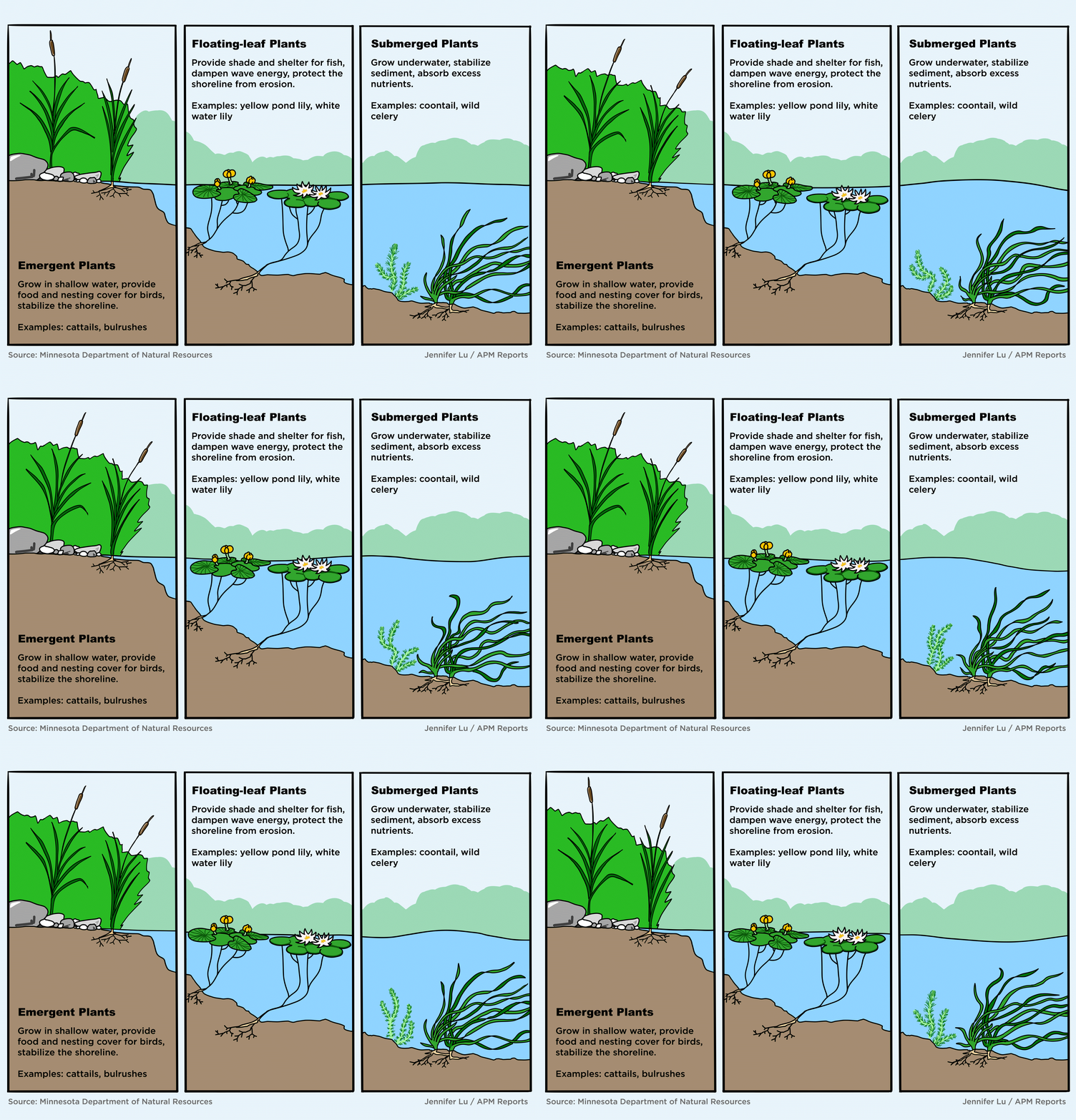
Those plants provide shelter for fish and other aquatic creatures. Their roots anchor the lake bottom, keeping sediment from getting stirred up and clouding the water. They take up nutrients from the bottom of the lake, which helps limit algae blooms.
Aquatic plants also help slow boat waves before they reach the shore, protecting it from erosion. On hot days, floating plants such as lily pads act like an umbrella for lake critters.
“They provide shade, so fish and invertebrates and other organisms get a little bit of break from that hot water and the sun,” Perleberg said.
Despite those benefits, Minnesota law allows property owners to remove some aquatic plants to create access for swimming or boating.
Another key reason for the loss of native aquatic plants is excess nutrients from urban storm drains and lawn fertilizers running off property that doesn’t have a buffer along the shore. Those nutrients can fuel algae blooms, which block sunlight and kill submerged plants.

“It wasn’t that long ago where our sewage went directly into the lakes. We thought of them as sort of the dumping grounds,” Perleberg said. “Now we’re paying the price for some of those things that we didn't know a lot about.”
A 2021 study highlighted the loss of native plant diversity in Minnesota lakes over the past century. Perleberg and her colleagues looked at data collected from lake surveys in the 1920s and 1930s, then resurveyed the same lakes.
In more than half of the lakes, they couldn’t locate at least one of the species that was common a century ago.
Leech Lake: A changing ecosystem
About 50 miles north of Nisswa, researchers on Leech Lake are studying whether an invasive plant, Eurasian water milfoil, is out-competing wild rice — and whether the loss of native vegetation has made the problem worse.
Leanna Goose, a researcher with the Leech Lake Tribal College and the Leech Lake Band of Ojibwe, remembers harvesting wild rice as a child when the rice beds seemed to stretch on forever.
“I used to lose my parents on it when I was a kid, and I would just wait at the edge of the rice bed because that's how big it was," she said.
Now, Goose said, some of those wild rice beds are small enough to see across. In places, they've been replaced by invasive Eurasian water milfoil, which has been in Leech Lake for more than two decades.

“We saw areas where there should have been manoomin, but there was just fields of Eurasian water milfoil instead,” she said. “So that was really concerning to see."
Goose is working on a project to restore wild rice in Leech Lake. On a warm August day, she and a team of researchers headed out by boat to a spot marked by a buoy. They pulled on snorkel masks and fins and dove beneath the surface.
Then, they resurfaced with armfuls of muddy Eurasian water milfoil, which they stuffed into mesh bags.
Raining White, deputy director of plant resources for the Leech Lake Band’s resource management division, hauled the waterlogged bags into his boat.
Tribal members have told White about native plants including water cabbage and lily pads that once grew in places where they fished. Some have disappeared.
White worries that removing native vegetation has helped create an opportunity for invasive plants to thrive.

“When people start removing things left and right because they want a sandy swim area or they want access to the lake, it kind of throws off the whole balance of the ecosystem,” he said. “Then you get things like invasive species moving in.”
White said aquatic plants often get a bad rap. In Indigenous teachings, everything in the natural world has value, he said.
“They help clean the water,” he said. “They provide fish habitat, waterfowl, food for humans — wild rice and other plants, food and medicines — and then food for our nonhuman relatives too.”
‘They just want to swim without any plants’
The DNR discourages the destruction of aquatic vegetation. But it also recognizes “that excessive plant growth may interfere with a homeowner’s reasonable need to access the water and recreate,” according to the agency’s website.
“We really want to protect that resource,” said Dean Paron, habitat program manager for the DNR’s fisheries section.
But at the same time, Paron said, lakeshore owners have the right to recreate on their property.
“So it’s a very delicate balance, but we’re doing the best we can,” he said.
Under Minnesota rules, a lakeshore property owner can cut or pull submerged vegetation in an area smaller than 2,500 square feet without a permit to create access for swimming or docking a boat. Property owners also can cut a channel up to 15 feet wide through floating vegetation to reach open water.

Larger clearing projects and using chemical herbicides require a DNR permit. Property owners often hire commercial companies to do that work, or do it themselves.
DNR staff review permit applications, visit the sites and work with property owners to make sure the removal is appropriate, Paron said. The DNR tries to steer people toward mechanical removal, but they often prefer chemical herbicides, he said.
“We try to make sure they’re using the right chemical in the right amount and in the right place,” Paron said.
When used carefully, chemical herbicides can be an effective tool to manage lake vegetation and reduce invasive species, said Jeff Forester, executive director of Minnesota Lakes and Rivers Advocates, which represents lake associations and property owners.
Today’s products are more targeted and used at much lower doses than in the past, Forester said.
“A lot of them are applied in parts per billion rather than parts per million,” he said. “That’s literally the difference between an applicator showing up with a couple of gallon jugs of product versus a tanker truck.”

But they can be overused, Forester said. One problem is people buying an aquatic herbicide at a local store and applying it illegally without a permit, making it harder to track and control.
Most people don’t understand the consequences of killing native aquatic plants, said Heather Baird, the DNR’s lake habitat supervisor based in Brainerd.
Aquatic vegetation can protect shorelines from costly erosion problems. The loss of those plants can be a strong indicator of where a shoreline is likely to crumble away, Baird said.
“We can basically look at an aerial photo and we can tell where the erosion is going to happen in the next few years,” she said.
Most anglers know the importance of aquatic vegetation for fish habitat. They often target patches of coontail or lily pads to catch that elusive bass or crappie.
But as Minnesota’s lakes get more heavily developed, some property owners only spend a few weeks at the lake every year, Baird said, and “don’t really respect and understand the importance of vegetation.”

“They just want to swim without any plants,” she said. “So that’s where the disconnect happens.”
Baird said if more people were aware of how many chemical pesticides are applied to Minnesota lakes every year, there likely would be more pushback.
Under a recently expanded Minnesota law, some aquatic pesticides are now considered to contain PFAS, a class of persistent human-made “forever chemicals” that don’t break down easily in the environment.
The DNR seeks to balance conservation of native plants with public recreation and access, Katie Smith, an assistant DNR commissioner, said in a statement responding to questions about how the agency regulates aquatic pesticides and plant life in lakes.
The agency recognizes that the same aquatic plants that may limit access from shore to open water also provide vital habitat that supports the lake’s overall health, she stated.
“It regulates activities that could harm aquatic vegetation and ensures removal is limited to what is necessary and sustainable,” Smith stated.
If the DNR finds clear evidence that aquatic plant removal is harming ecosystems, it can limit those activities, Smith stated. But she said currently, it doesn’t have evidence to support changing state laws or rules.
Chemical concerns
Some lake residents have raised concerns about the potential effects of chemicals on fish, other aquatic life, even humans. They’re seeking more natural alternatives.
Waterfront Restoration, a company based in the Twin Cities suburb of Long Lake, removes lake plants for homeowners, usually to clear a swimming area or make it easier to navigate a boat. Instead of chemicals, scuba divers remove invasive or native vegetation by hand.
“Especially if their kids are swimming, there's just uncertainty I think for a lot of people around the chemicals,” said Tom Suerth, the company's founder and president. “Whether it’s kids, pets, their lawn or whatever, they kind of prefer the peace of mind of not using them.”

There’s an educational aspect to the work they do, Suerth said. Some homeowners want the company to make their lakefront into a pool, with a perfect sandy bottom and nothing growing.
“Ninety-nine percent of the time, that’s not possible,” Suerth said.
Instead, his company encourages homeowners to leave some native plants to help prevent invasive species from moving in.
“As soon as you clear the space, nature's going to fill it with something probably a lot worse,” Suerth said.
Hoping for change
The research team from the Leech Lake Band of Ojibwe will continue its work this fall, after the wild rice harvest.
They’ll return to the spots where they removed Eurasian water milfoil and plant locally harvested wild rice seeds. Next year, they’ll survey the areas again next year to see if there's been a resurgence of wild rice, and a decline of invasive milfoil.

White is also launching a project to map the aquatic vegetation across Leech Lake, and compare it with maps from 20 years ago. He hopes that will show how much the lake’s plant communities have changed, and provide clues about what’s driving those changes.
With what they learn, White hopes to raise people’s awareness and understanding of aquatic plants as vital to a lake’s health, rather than a nuisance.
“If this water is here for all of us and it's supposed to benefit Minnesota and the Leech Lake Reservation, then why are we letting individuals go in and remove things that belong to all of us, that benefit all of us?” he asked. “It’s really something I can’t wrap my head around. Hopefully it’s changing.”