Minneapolis Public Schools proposes closing schools amid budget challenges
Go Deeper.
Create an account or log in to save stories.
Like this?
Thanks for liking this story! We have added it to a list of your favorite stories.


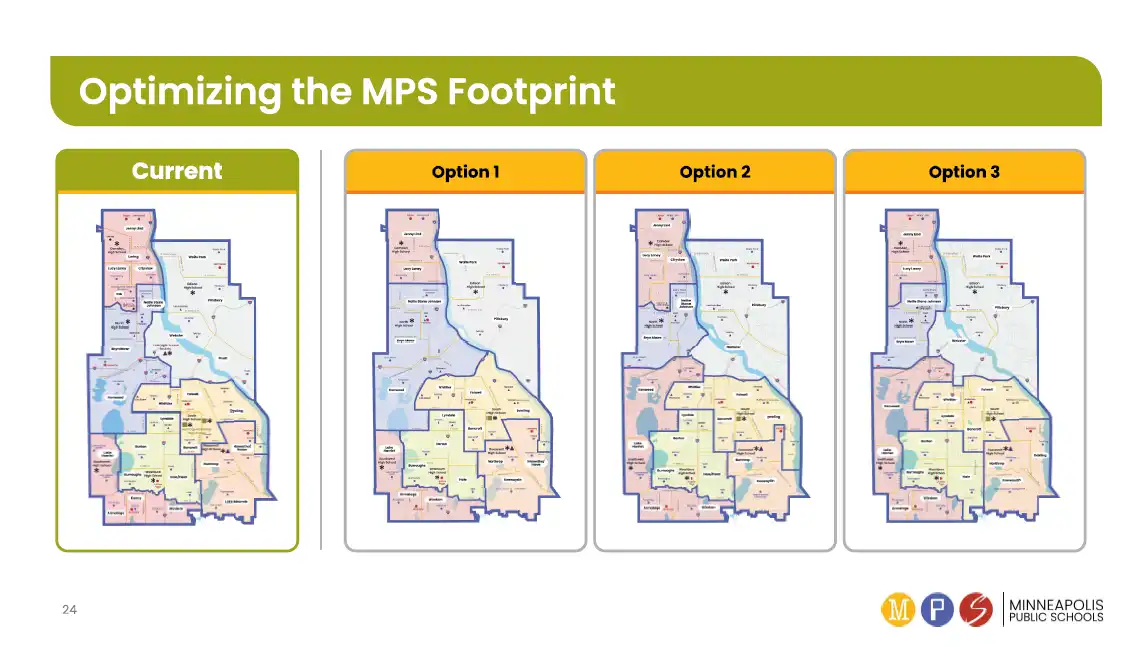
The Minneapolis school district this week revealed a proposal to address its longstanding budget issues by consolidating programs, redrawing attendance boundaries and moving thousands of students to different schools.
As many as 16 buildings could lose their current academic programming under the proposals, although the district stopped short of describing the buildings as closed schools. District officials said the buildings could potentially be used for other purposes in the future but did not offer a timeline for repurposing the buildings.
The district estimates the proposals would affect between 12 percent and 14 percent of students through school mergers or attendance boundary changes.
The district has been sounding the alarm about a budget crisis for several years. Falling enrollment is a major factor. In 2023 it started what it calls a “school transformation” process to “reimagine” the district.
Turn Up Your Support
MPR News helps you turn down the noise and build shared understanding. Turn up your support for this public resource and keep trusted journalism accessible to all.
In 2024, school leaders conducted a walk-through to review the district’s buildings. They found more than half were considered underutilized and being used at a rate of 70 percent of their capacity or less.
In a video statement released to the community, superintendent Lisa Sayles-Adams said steps to increase enrollment and decrease spending have not been enough to address the district’s budget issues.
“The reality is our district is spread too thin, which means resources are used to support an inefficient footprint instead of directly supporting student experiences,” Sayles-Adams said.
She pointed to chronic underfunding, open enrollment and demographic changes as factors contributing to the district’s financial challenges.
Earlier this year, district leaders uncovered a mistake in billing practices that, when corrected, added more than $10 million to the budget than projected. Outside investigations also revealed $3 million diverted from an employee health fund.
The Minneapolis school district is among many in Minnesota facing falling enrollment and steep financial challenges.
Earlier this year, a survey revealed that more than half of the districts in the Twin Cities region said they expected a combined budget shortfall of more than $220 million for the 2026-27 school year.
Five years ago, the St. Paul school district closed or combined six schools in order to address challenges resulting from falling enrollment.
The Minneapolis Federation of Teachers criticized the district’s proposals on Tuesday.
“There are certainly those who see public schools as little more than a book of assets to be liquidated and transferred to private interests. These forces have long sought to use the ‘transformation’ moniker as a shield for this work. That is not transformation but something wholly different,” MFT leaders said in a written statement.
Union leaders instead urged the district to focus on increasing enrollment and “building a robust recruiting and retention pipeline to make it appealing to enroll at MPS over any other option.”
Sayles-Adams acknowledged that the proposals to close schools will likely be met with concern.
“But the alternative is continued budget cuts, schools with too few students, a struggle to provide consistent opportunities across the city, and ongoing instability,” Sayles-Adams said.
School board member Greta Callahan says she’s concerned that affected communities are already being notified, even though the board hasn’t approved a plan.
“We, the board, have not voted on a single one of these options for closures. We don't have to accept any of these options,” said Callahan. “We have not agreed to any of them. But now the list is out. School communities are being notified on potential closures before the body responsible for approving those closures has voted. This is not engagement or thoughtful planning.”
The district plans to collect public feedback through mid-October before the board votes on a proposal in November. The district could begin implementing the changes in the 2027-28 school year.